
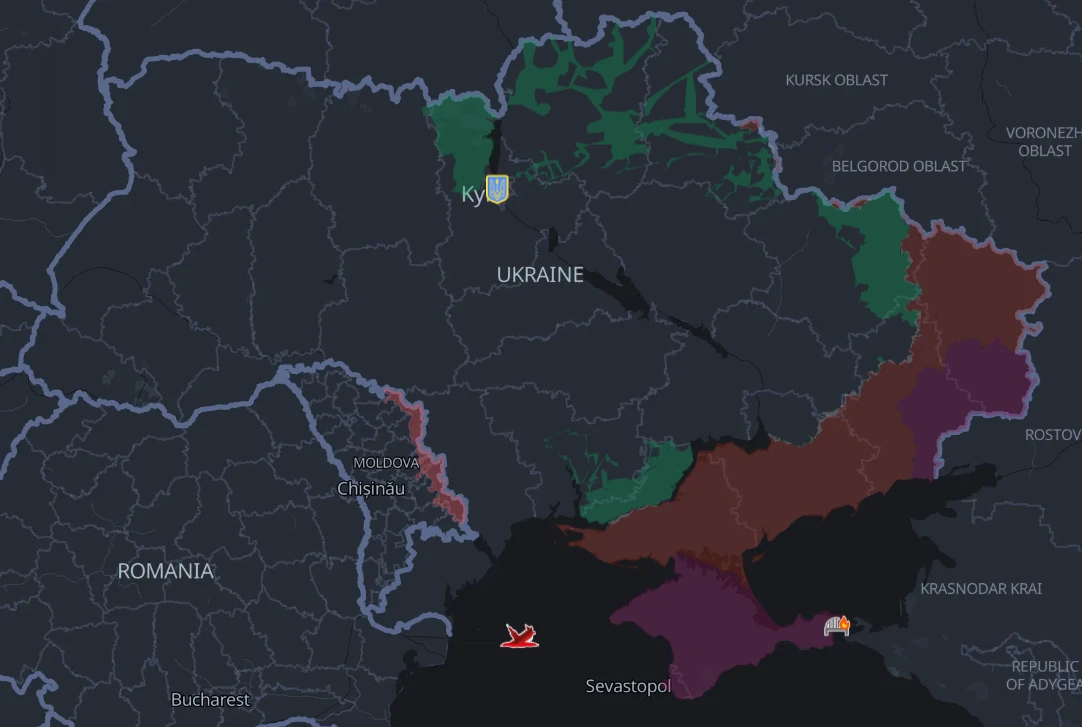
This archival record documents the pivotal military, economic, and geopolitical developments on Day 1556 of the full-scale war in Ukraine. The situational overview covers a notable expansion of long-range asymmetric warfare, highlighted by a Russian drone strike impacting NATO territory and a series of successful Ukrainian deep strikes against Russian petrochemical infrastructure. Additionally, this entry analyzes the intensifying internal pressures within the Russian Federation, tracking shifting state propaganda narratives, severe industrial wage arrears, and systematic media censorship designed to conceal the compounding costs of the conflict.
Cross-Border Escalation and Attacks on Civilian and Commercial Infrastructure
This section records recent long-range strikes impacting civilian areas inside Ukraine and territory belonging to neighboring states. It also covers targeted kinetic operations against commercial shipping infrastructure in the Black Sea.
The Romanian Airspace Violation in Galati
On May 29, a Russian kamikaze drone crossed into NATO airspace and struck a civilian multi-story building at 50 Brăilei Street in Galați, Romania. The impact caused an explosion and a fire on the tenth floor, resulting in the emergency evacuation of 70 residents and injuring two Romanian citizens. The Romanian Air Force responded by scrambling two fighter jets and a helicopter with authorization to fire on radar-detected targets.
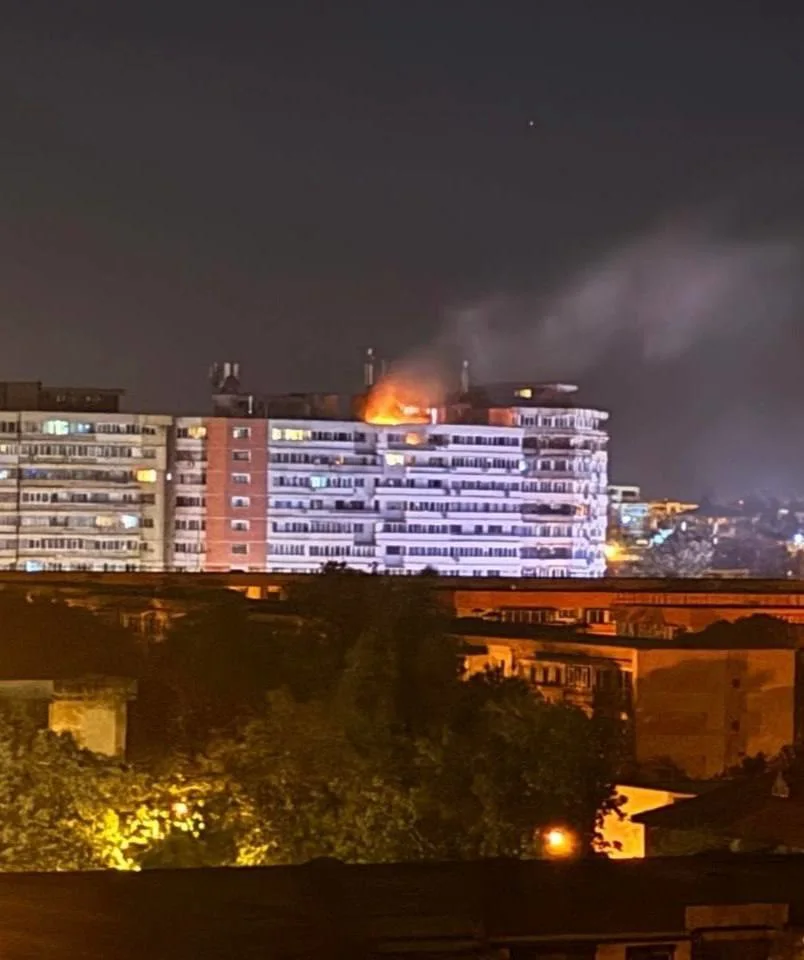
Following the strike, Romanian Foreign Minister Oana Silvia Cioru condemned the incident as a serious escalation. She formally requested that NATO allies accelerate the delivery of anti-drone counter-measure systems to secure the country’s 650-kilometer border with Ukraine.
Russian Ground Bombardments in Kherson and Regional Centers
In the Korabelny district of Kherson, Russian forces utilized Multiple Launch Rocket Systems (MLRS) to shell a civilian children’s playground. The bombardment resulted in the immediate death of a local father, while his 36-year-old wife and their two daughters, aged three and six years old, suffered severe shrapnel injuries.
In the Odessa region, a Geran-2 drone strike damaged residential homes, a Nova Poshta postal hub, and a grocery store, leaving 11 civilians injured, including two children. Concurrently, the Dnipropetrovsk region faced over 20 artillery and drone attacks, damaging three energy facilities and leaving 63 settlements without power, while similar strikes on farms in the Chernihiv region killed one person.
Drone Interceptions in Black Sea Commercial Shipping Corridors
A Turkish-owned cargo vessel flying the Vanuatu flag was struck by a drone in its superstructure after departing a port in the Odessa region. The attack caused a localized fire and injured two crew members, who were subsequently evacuated by the Ukrainian Naval Forces.

Separately, three commercial oil tankers connected to Russian oil exports — the James II (Palau flag), the Altura, and the Velora (both Sierra Leone flags) — were targeted by drones 80 kilometers north of Türkeli, Turkey. These vessels belong to Russia’s shadow fleet and were performing a ship-to-ship fuel transfer for the state-owned oil company Rosneft. The Turkish Coast Guard deployed units to manage the incident, as all three ships are currently under EU, UK, Canadian, and Swiss sanctions.
Modernization of Ukrainian Strategic Aviation and Air Defense Platforms
This section details the long-term international military assistance frameworks established to upgrade Ukraine’s aerial capabilities. It covers platform acquisition schedules and technical integration details.
Sweden’s Saab Gripen Fighter Jet Commitment
The Swedish government finalized a defense support package to transfer 16 Saab JAS 39 Gripen C/D fighter jets to the Ukrainian Air Force free of charge, with deliveries beginning early next year. Concurrently, Ukraine will utilize 2.5 billion euros from European Union credit lines to purchase 20 next-generation Saab JAS 39 Gripen E/F variants.
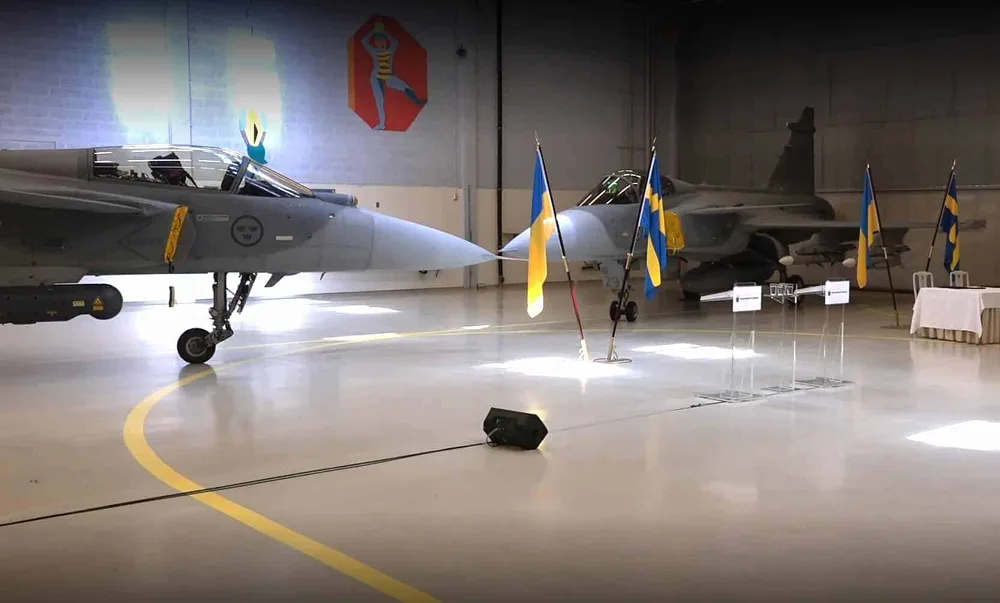
Swedish Defense Minister Pål Jonson stated that the long-term objective is providing Ukraine with 100 to 150 fighter jets. Specialized training for Ukrainian pilots and technical support crews will expand this autumn. The bilateral agreement includes a binding project to fully localize Gripen manufacturing and assembly inside Ukraine by 2033, covering both kit assembly and component production.
Strategic Range of the Meteor Missile System
The operational capability of the Gripen fleet will be enhanced by the integration of the Meteor Beyond-Visual-Range Air-to-Air Missile (BVRAAM), produced by the European consortium MBDA. This missile utilizes a throttleable solid-fuel ramjet engine that preserves maximum kinetic energy throughout its flight profile. It features an official range of 120 kilometers and an estimated maximum engagement envelope of up to 200 kilometers.
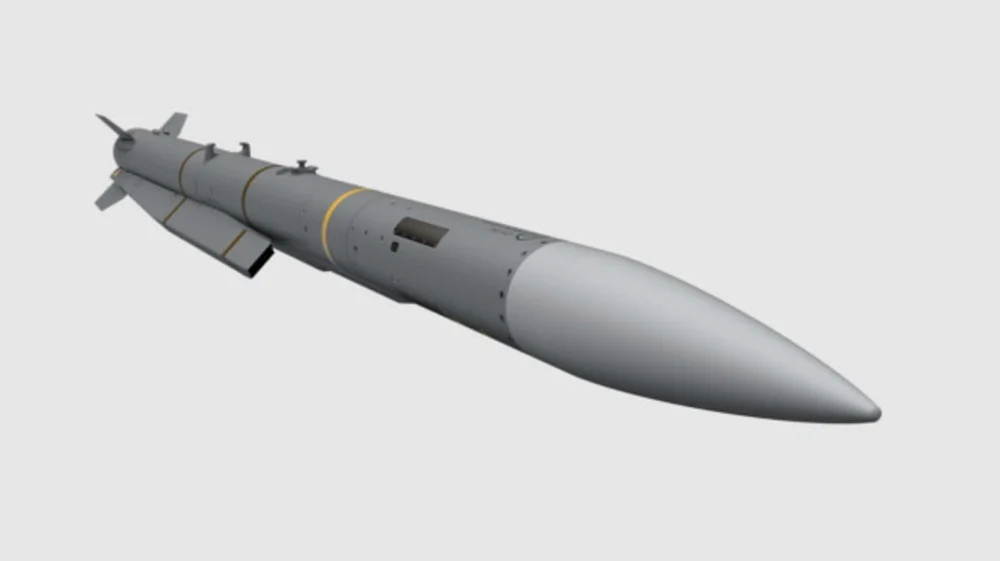
President Volodymyr Zelenskyy noted that these long-range missiles are explicitly intended to counter Russian Guided Aerial Bombs (KABs). By targeting Russian Sukhoi fighter-bombers at long ranges, the system aims to force them to launch sorties further away from the frontline, reducing their operational effectiveness.
Asymmetric Deep Strikes on Russian Energy and Military-Industrial Complexes
This section records Ukraine’s long-range precision drone and missile operations within the Russian Federation. These actions target state revenue streams and primary military manufacturing nodes.
Interception of the Lukoil-Volgograd Refinery and Strategic Targets
Ukrainian long-range drones conducted a successful strike against the LLC Lukoil-Volgogradneftepererabotka facility, the largest refinery in the Volgograd Oblast. This refinery is owned by Lukoil and processes over 15 million tons of crude oil annually. Photographic and geospatial data confirmed a large fire across its deep-processing columns, marking at least the tenth successful drone strike on this site.
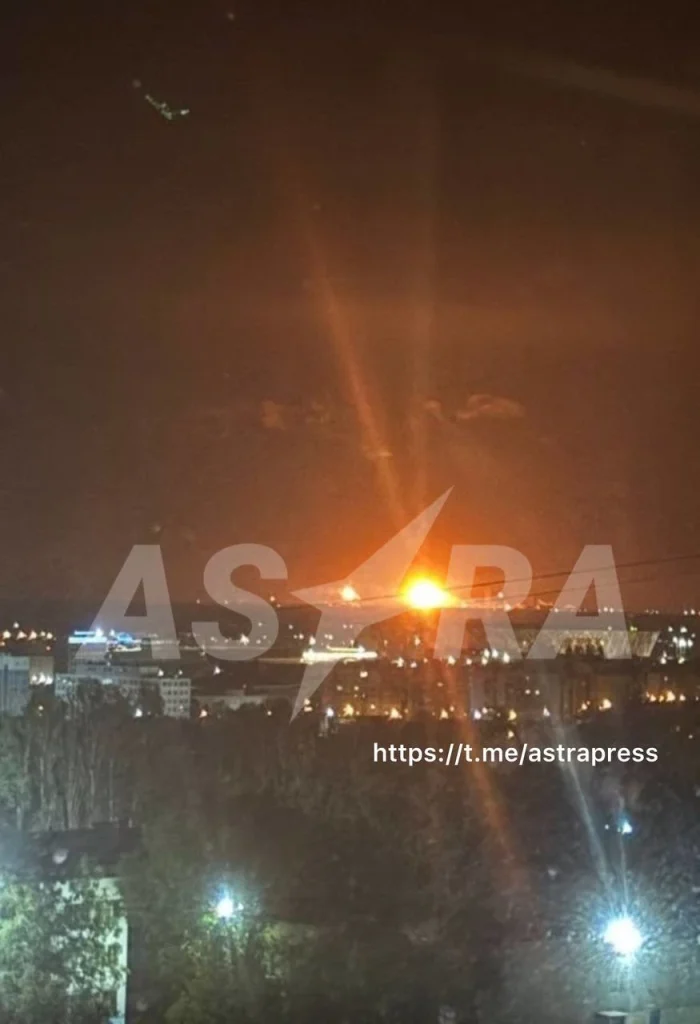
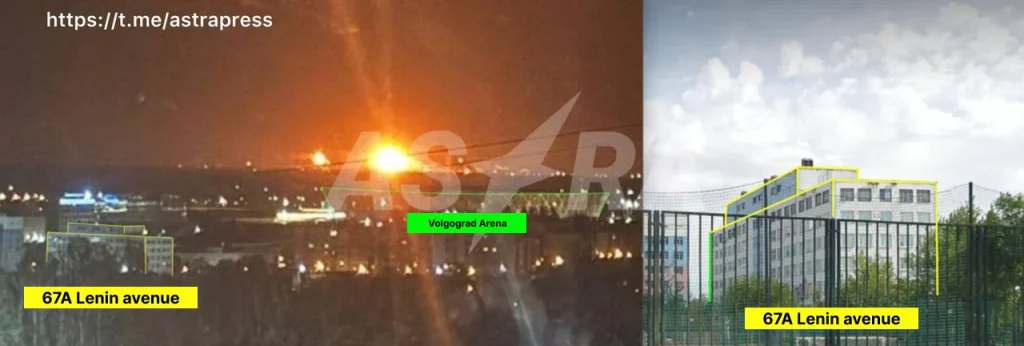
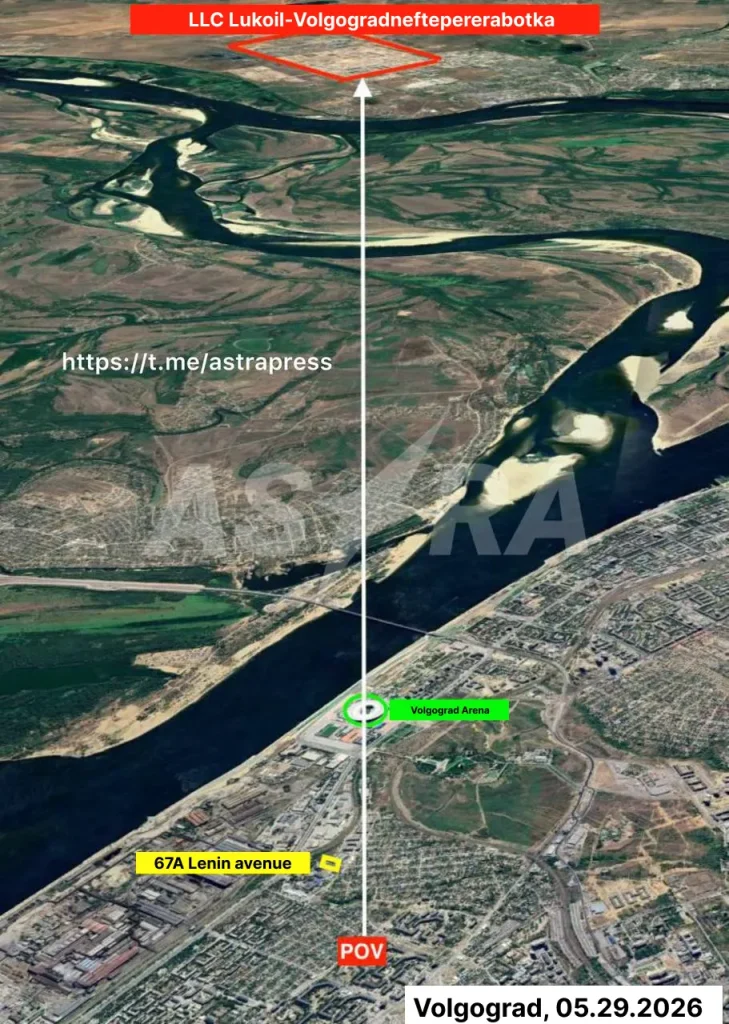
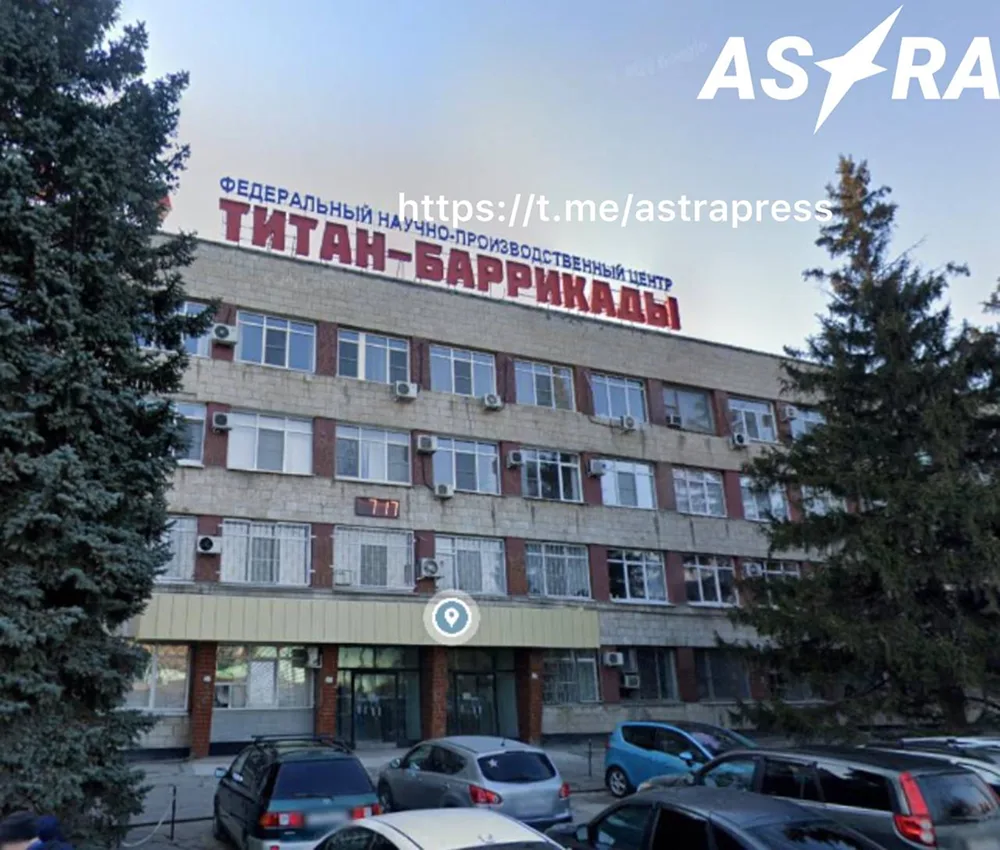
An additional drone crashed into an apartment building in Volgograd’s Krasnooktyabrsky district. Investigation showed this location is two kilometers from the Federal Research and Production Center Titan-Barrikady. This highly classified Roscosmos State Corporation enterprise manufactures mobile launch units for strategic nuclear missiles including the Yars, Topol-M, and Sarmat, alongside Iskander-M tactical missiles.
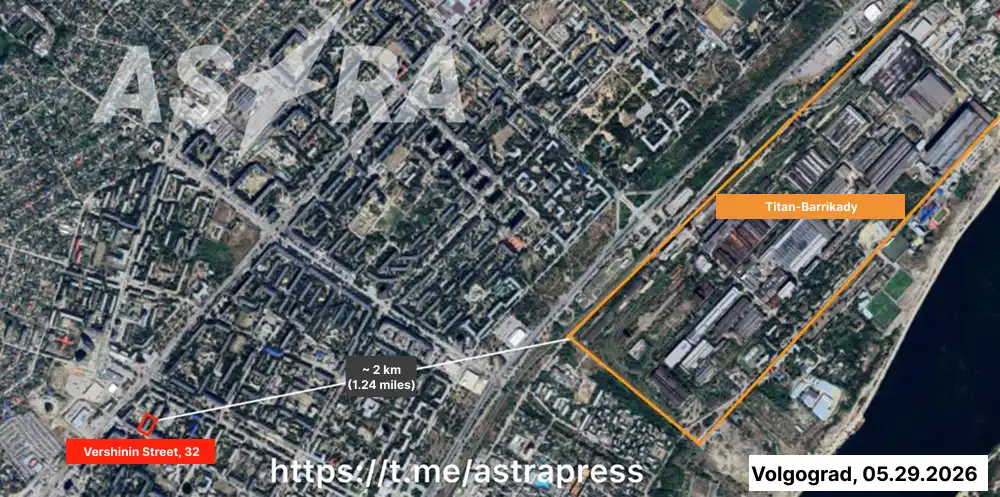
Drone Swarms in Yaroslavl and Nizhny Novgorod
In Yaroslavl, a Ukrainian drone swarm struck the southern industrial district, hitting fuel depots owned by Slavneft-Yaroslavnefteorgsintez, the Yaroslavl Oil Depot, and the Specneft Plus transshipment facility, which has a capacity of 300,000 cubic meters. Regional governor Mikhail Yevrayev closed the main highway from Yaroslavl to Moscow due to the resulting fire.
The General Staff of the Armed Forces of Ukraine also confirmed using British Storm Shadow cruise missiles to strike military intelligence and automation hubs in Voronezh, Taganrog, and Sevastopol, while a separate strike hit a refinery in Tuapse. In the Nizhny Novgorod region, a drone damaged an administrative building 500 meters from the Gidromash plant, a major enterprise producing landing gear, hydraulic cylinders, and flight control components for military aircraft.
Rosstat Data on Declining Petrochemical and Fuel Production
Official production statistics released by the Russian state agency Rosstat confirmed substantial damage to the domestic industrial base. In April, the total domestic production of refined petroleum products and coke experienced a 12.3% drop compared to March.
Year-over-year figures showed that Russia’s aggregate petrochemical and refining output fell by 9.2%. This contraction directly limits the Kremlin’s ability to generate foreign currency reserves through fuel exports and disrupts internal military logistics supply lines.
Kremlin Security Responses: Roof Deployments and Industrial PVO Regulations
This section outlines the domestic defensive re-organizations enacted by Russian authorities to counter continuous airspace violations. It examines the legal and logistical adjustments made by state and corporate actors.
Pantsir-SMD Roof Installations Over Moscow
Military authorities used Mil Mi-26 transport helicopters to place newly modified Pantsir-SMD air defense systems onto the roofs of Moscow skyscrapers, including the Nordstar Tower business center. The Pantsir-SMD variant is specifically designed to counter low-altitude kamikaze drone swarms.
🚁Mil Mi-26T.. heavy transport helicopter.
— Massimo Frantarelli (@MrFrantarelli) May 27, 2026
Pantsir-SMD" ADMS?
🎥"chegara.siz" pic.twitter.com/WEAwTKQLsg
This system replaces traditional twin 30mm automatic cannons with an expanded missile payload. It carries standard 95Ya6 interceptor missiles with a 20-kilometer range alongside compact TKB-1055 mini-missiles designed to hit small drones up to 7 kilometers away. The deployment highlights a decision by the Ministry of Defense to protect administrative districts in Moscow while leaving regional industrial sites exposed.
Corporate Air Defense Laws and the Balance of Balance Sheets
Due to state air defense shortages, a new legislative mechanism reported by the business daily RBC allows private industrial firms to independently buy military-grade hardware. Companies can purchase anti-aircraft artillery, automated turrets, radar arrays, and electronic warfare (EW) networks.
To prevent independent armed factions following the Yevgeny Prigozhin and Wagner Group mutiny, the law mandates that all privately funded hardware must be transferred to the balance sheet of the Russian Armed Forces. Private owners finance the equipment, but state military personnel operate it and retain the right to reallocate the systems to other regions, which corporate insiders believe will limit the program’s efficacy.
The Airports of Regions Electronic Warfare Petition
A formal petition to Vladimir Putin was briefly published (now it is deleted but available in the archives) on the website of Airports of Regions, a corporate holding managing major air hubs in Yekaterinburg, Samara, Nizhny Novgorod, Saratov, and Rostov-on-Don. The document, signed by director Evgeny Chudnovsky, criticized the Federal Security Service (FSB) and the Ministry of Defense.
Chudnovsky stated that security agencies were unilaterally placing combat aircraft and high-power electronic warfare (EW) jamming systems inside civilian airfield perimeters. He warned that uncoordinated military jamming in civil air corridors disrupted passenger radar and navigation, creating immediate risks of an aviation crash. State censors quickly removed the website and scrubbed references to the petition.
Frontline Assessments, Attrition Metrics, and NATO Defensive Simulation Games
This section analyzes the current tactical situation on the ground in eastern and southern Ukraine. It incorporates verified human loss statistics and strategic defense modeling.
Playfra’s Field Intelligence and Tactical Updates
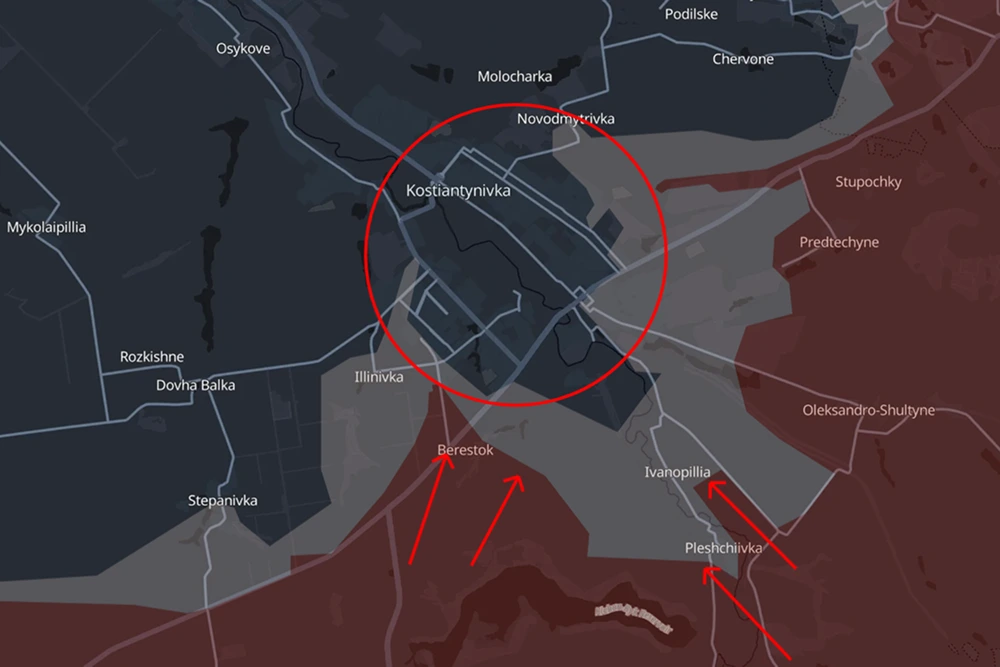
Frontline updates from researcher Playfra indicate significant tactical shifts around Kostiantynivka, where the grey zone and Russian control lines have expanded. The majority of Ukrainian reconnaissance drone operators have completed their relocation to safer positions outside the town, though several teams remain active inside the urban area. The dense urban layout, combined with the reduction in close-range aerial surveillance, has allowed Russian infantry to execute deeper infiltrations. A Russian soldier was recently neutralized in the northwestern Nakhalovka district, confirming fluid frontlines, while the eastern sector remains more securely under the control of the 36th Marine Brigade. Ukrainian forces also maintain positions in Pleshcheevka and Ivanopolye directly to the south.
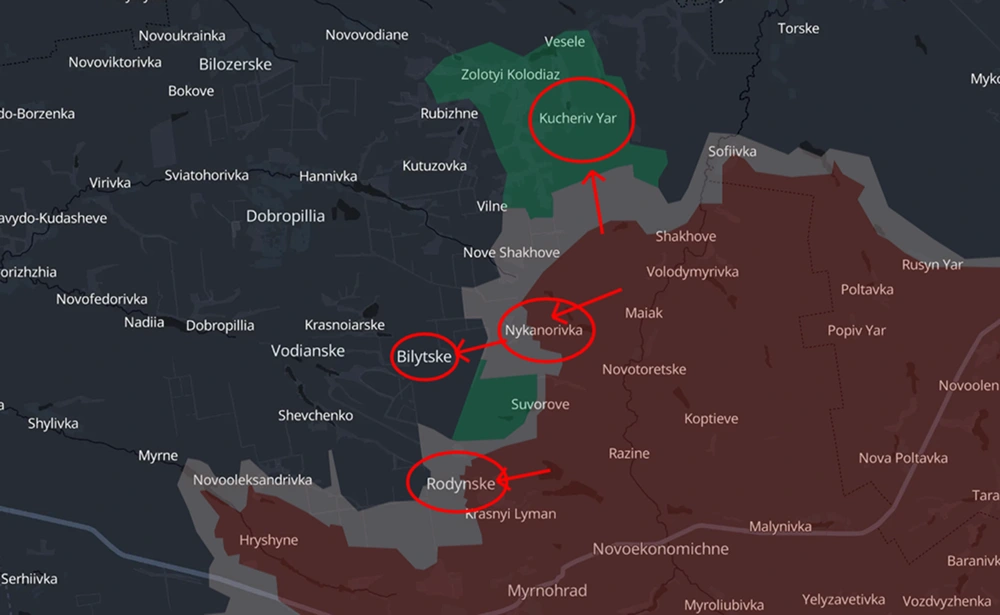
On the Dobropillia direction north of Pokrovsk, the overall defensive situation remains relatively stable. The Azov Brigade is successfully holding its assigned sector using a doctrine of active defense combined with localized counter-attacks within the grey zone. While the Russian 51st Army faces severe combat exhaustion, Ukrainian infantry units also experience fatigue, particularly along the Kucheriv Yar-Nikonorivka-Zapovednaya line. Due to these heavy losses, the Russian command has deployed elements of the 41st Combined Arms Army to reinforce this specific axis.
In Rodinskoe, a vital suburb near Pokrovsk and Myrnohrad that has resisted capture for nearly six months, conditions for the remaining Ukrainian defenders are deteriorating. Russian forces have established their own drone pilot positions within the town, and the Russian controlled area is expected to expand across the remaining ruins. Conversely, the situation in neighboring Belitskoe remains more secure, with a dominant Ukrainian presence. However, conducting routine clearing operations there has become increasingly difficult due to Russian FPV drones and KAB guided bombs. Ukrainian soldiers highly praise the exceptional defensive efficacy of pre-constructed anti-tank trenches and razor-wire entanglements, which successfully slow down Russian ground movements, despite seasonal foliage facilitating small-scale enemy infiltrations.
In the southern theater near Zaporizhzhia, Playfra refuted Russian Ministry of Defense claims regarding the capture of Vozdvizhenka (northwest of Huliaipole). Video evidence confirmed the destruction of Russian flag-planting teams, and the village remains under Ukrainian operational control. Ukrainian support units remain active in the area, and ground drones (NRKs) routinely transit through the settlement, a logistical movement impossible in Russian-held or contested grey zones. While nearby Ternovataya remains under Ukrainian control, Russian elements have been detected near Kosovtsevo. Intensive Russian use of glide bombs and heavy drone coverage complicate the movement of Ukrainian automated hardware, but the lack of a permanent Russian physical presence confirms that Moscow does not control the area.
Realities on the Kharkiv, and Sumy Sectors
In the Kharkiv region, military analyst Konstantin Mashovets confirmed that:
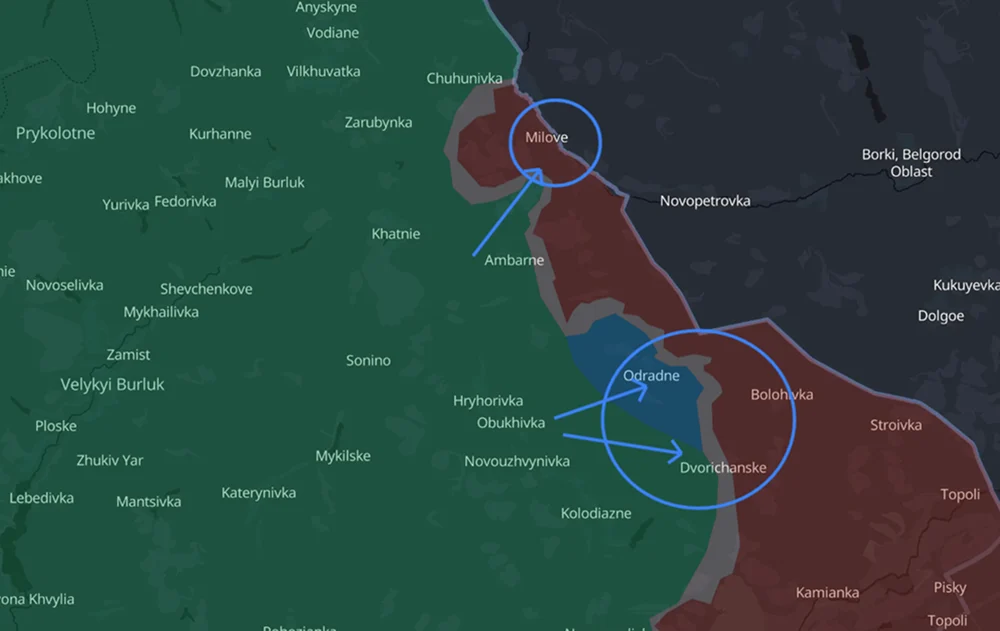
- Ukrainian troops liberated the village of Otradne, advancing 3.2 kilometers along a 7-kilometer front and disrupting Russian plans toward Velykyi Burluk.
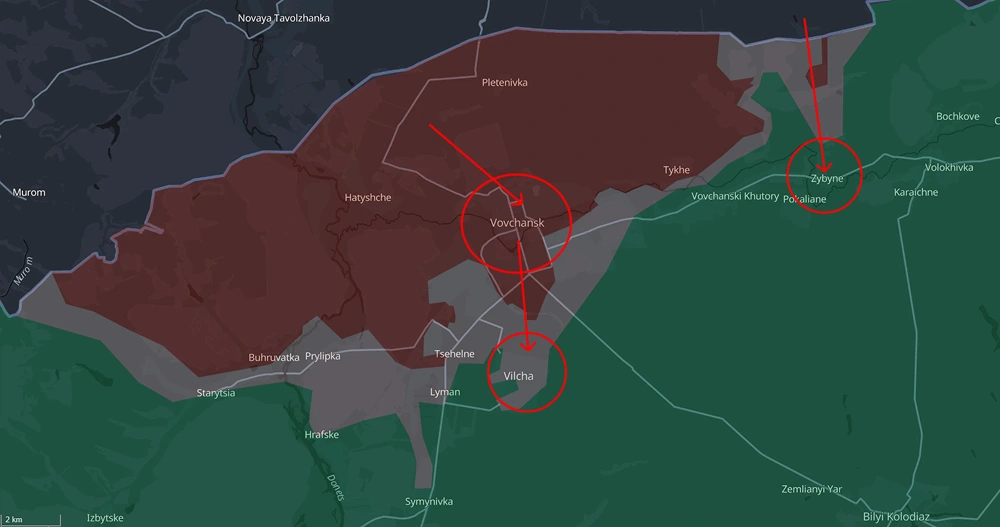
- Russian forces advanced 3.7 kilometers east of Vovchansk toward Zybino but failed to capture the settlement, while their motorized attacks south of Vovchansk were repelled.
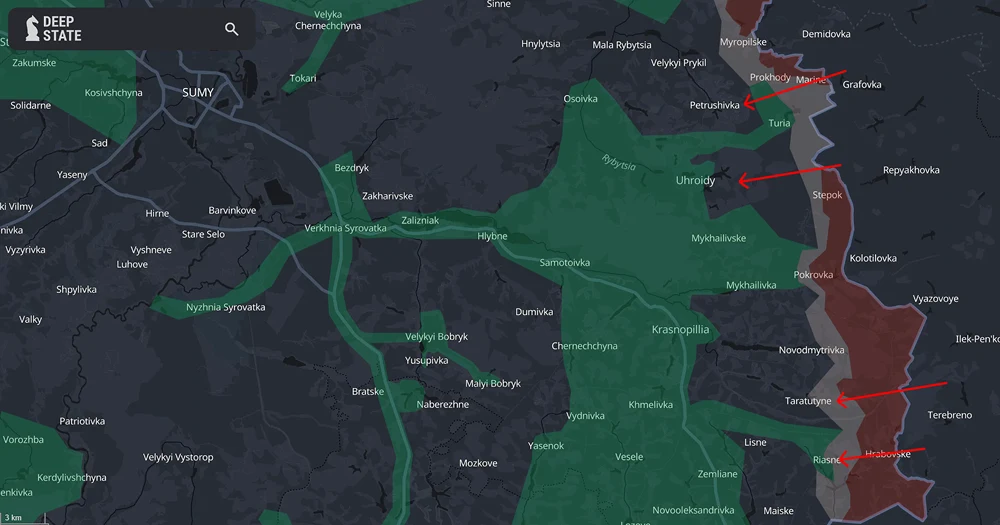
- In Sumy Oblast, Russian forces control only the southeastern portion of Riasne after two weeks of fighting, while their assaults on Turya and Petrushevka failed.
- In Vozdvizhivka (Zaporizhzhia), Russian capture claims were disproven, as Ukrainian ground drones (NRKs) continue to operate throughout the village.
Oko Gora Statistical Analysis on Frontline Advances
Data compiled by the Ukrainian analytical resource Oko Gora for the tracking period of May 17 to May 24 outlines the exact rate of Russian territorial gains. During this week, the total area of newly occupied Ukrainian territory increased by 14 square kilometers. This follows a recorded advance of just 1 square kilometer during the preceding week, and 17 square kilometers the week prior to that. While the shift from one to fourteen square kilometers represents a nominal fourteen-fold acceleration in frontline movement, both figures remain strategically negligible on the scale of the entire theater.
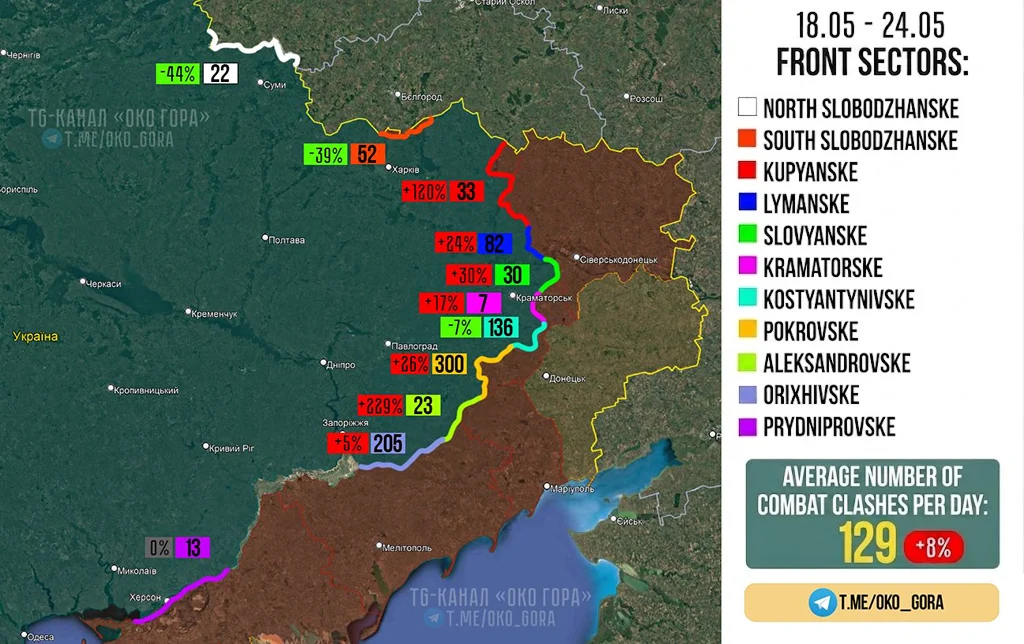
Statistical analysis of Ukrainian General Staff reports by the same resource shows that the absolute volume of frontline combat engagements increased by 8% compared to the prior week, averaging 129 daily clashes. While this intensity is lower than the peak numbers recorded last year, the corresponding rate of physical advancement has decreased sharply. Aggregate data indicates that May is on track to be the least effective month for Russian offensive operations since March 2024.
The 500,000 Casualty Threshold and Actuarial loss Models
Anne Keast-Butler, Director of the British intelligence agency GCHQ, stated that total Russian personnel losses since 2022 have reached 500,000 killed. This high casualty rate stems from tactical commands deploying infantry units into drone-monitored zones to conduct superficial “flag-planting” actions for domestic propaganda.
BREAKING: Almost half a million Russian soldiers have been killed since Vladimir Putin launched his war in Ukraine, Anne Keast-Butler, the director of the UK spy agency GCHQ, has revealed in an inaugural lecture. She says this figure is based on “new intelligence”.
— Deborah Haynes (@haynesdeborah) May 27, 2026
"As we remain…
While independent outlets Mediazona and the BBC Russian Service have verified the names of 220,000 dead Russian soldiers, total models place the actual death toll between 350,000 and 500,000. This scale of attrition creates structural labor shortages within Russia and strains frontline troop rotations.
NATO’s Lithuania War Game and Autonomous AI Drone Swarms
The Times published details of a NATO war game simulating a Russian multi-axis invasion of Lithuania via Belarus, Kaliningrad, and eastern Latvia. In the standard baseline scenario using conventional doctrine, the capital city of Vilnius was encircled by Russian forces within five days.
A secondary simulation introduced forward defense units equipped with thousands of autonomous drones integrated with Artificial Intelligence (AI). Operating without human pilots and remaining immune to electronic warfare (EW) jamming arrays, these AI drone swarms tracked and destroyed one-third of the Russian invasion force within the first ten days, completely stopping the offensive and demonstrating the defensive utility of automated systems.
Socio-Political Strains inside the Russian Federation and Conscription Abuse
This section documents the domestic ideological shifts and economic censorship trends occurring within the Russian Federation. It focuses on the internal preservation of the war narrative.
The ‘Beneficial Defeat’ Narrative Shift in State Media
The pro-Kremlin newspaper Moskovsky Komsomolets published (the article was deleted, the link leads to the archived version) an ideological essay by attorney Dmitry Krasnov, a member of the Public Chamber of Moscow. Titled “A Striking Defeat: When Geopolitical Losses Can Be More Useful Than Brilliant Victories,” the article argues that historical military defeats have benefited the Russian state.

Krasnov claimed that geopolitical losses and “shameful peace treaties” are positive because they result in the “de-fatting and purging of corrupt, decadent ruling elites,” expand civil freedoms, and trigger future imperial growth. Analysts suggest this essay represents a coordinated psychological effort by the Administration of the President to prepare the Russian public for potential territorial compromises.
Servicemen Exploitation: The Cases of Leonid and Danil Akserov
The independent investigative outlet Astra documented the treatment of a contract soldier named Leonid, who was sent to the front line with 1.5 weeks of training, sustaining wounds and a kidney infection. After asking for a discharge, the FSB accused him of attempting to surrender, subjected him to interrogation threats, and held him in a subterranean earth pit for two months near Luhansk until his condition required the surgical removal of his infected kidney. Despite this, medical officials in Podolsk falsified his documents to return him to an assault unit, forcing him to desert.

A similar pattern was recorded with Danil Akserov, an 18-year-old conscript from Komsomolsk-on-Amur. Following sleep deprivation and threats of an espionage prison sentence by his commander, Lieutenant Terentyev, he was forced to sign a contract. Bypassing an ongoing court appeal, he was deployed into a frontline assault unit near Mariupol and has been missing and presumed dead since May 14.
Rosstat Wage Arrears and Media Deletion Directives
Official data from Rosstat revealed that by the end of April, total unpaid wage arrears across the Russian Federation reached nearly 3 billion rubles. This represents a 35% increase in one month and a 94.3% increase compared to last year, directly affecting over 19,000 industrial workers.
The Kremlin issued an emergency directive ordering state media networks like TASS, RIA Novosti, and Interfax to suppress the report. Publications including Kommersant, Komsomolskaya Pravda, and Ura.ru initially published articles detailing the wage crisis, but state security censors forced them to delete the text from their websites within hours, leaving only search engine cache previews.
The material was created based on a video by Michael Nacke →