
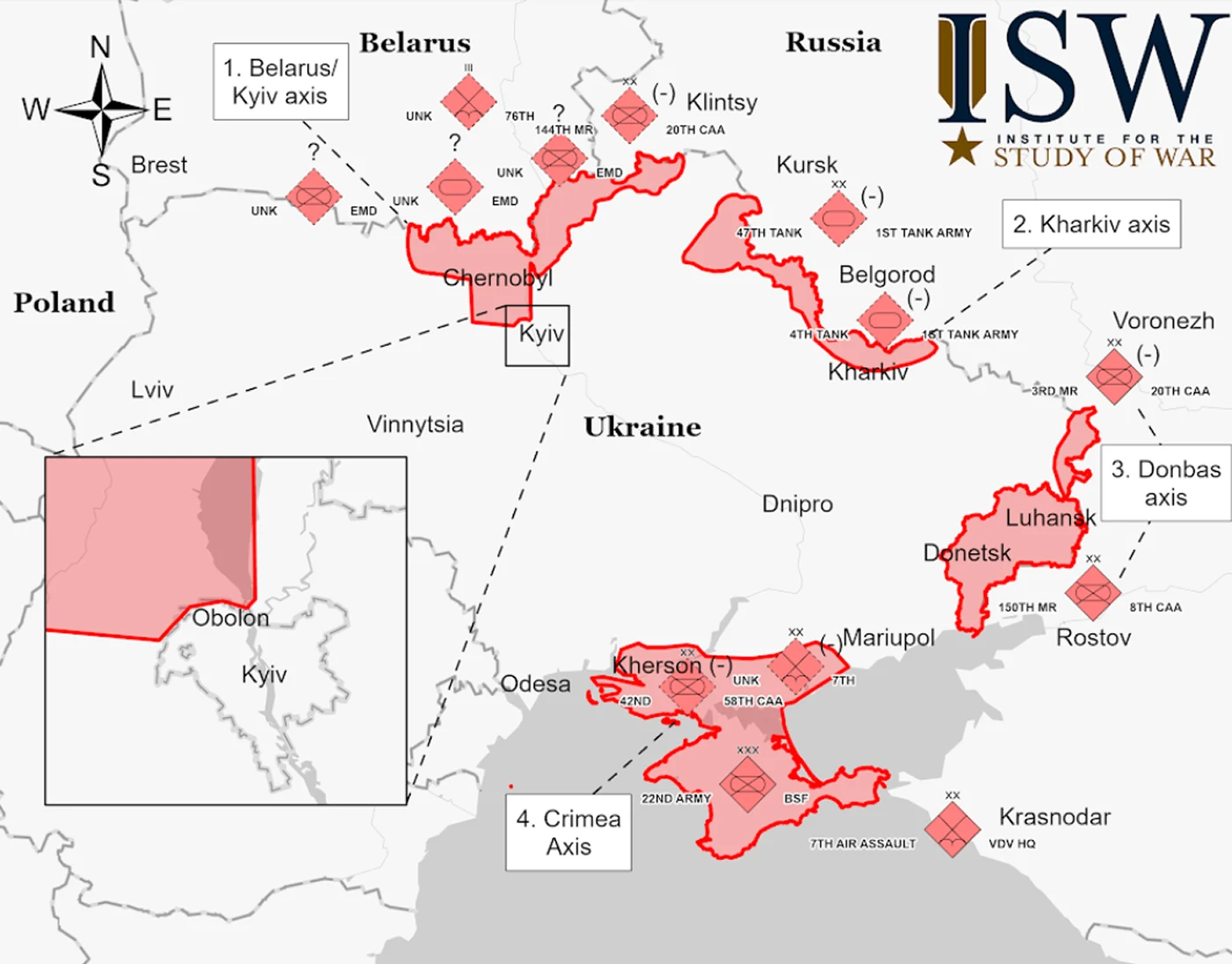
The second day of Russia’s full-scale invasion of Ukraine was marked by a desperate attempt to capture the capital, the first documented instances of war crimes involving perfidy (disguise), and a staggering level of logistical disarray within the Russian ranks. While the Kremlin attempted to project an image of an unstoppable “blitzkrieg,” the reality on the ground revealed a different story.
1. The Battle for the Capital: Infiltration and Sabotage
The early hours of February 25 saw the war reach the streets of Kyiv. Unlike the traditional frontline combat seen in the south and east, the battle for the capital began with clandestine operations.
Perfidy and Disguise
Reports from the Conflict Intelligence Team (CIT) confirmed that Russian special operations groups attempted to penetrate Kyiv wearing Ukrainian military uniforms. These saboteurs (DGR groups) were spotted in several districts, often identified by their lack of local accents or lack of knowledge of basic geography while asking for directions to the city center.
The “Tricolor” Marking Theory
Observers noted a psychological marking system. While invading forces from the Belgorod axis wore white armbands and the Crimean axis wore red, saboteurs in Kyiv were reportedly seen with blue armbands — a cynical attempt to mimic Ukrainian markings or complete a “white-blue-red” tricolor scheme across the invasion fronts.
The Hostomel Gambit
The Russian command continued its high-stakes attempt to seize Hostomel and other suburban airfields. The strategic goal remained the same: secure a landing strip for Il-76 transport planes to ferry thousands of paratroopers directly into the capital. By the end of day two, this “air bridge” had not been established, forcing Russian forces into grueling ground skirmishes on the outskirts.
2. Fact-Checking the “Strela-10” Incident
One of the most viral images of the day involved a Strela-10 anti-aircraft vehicle crushing a civilian car in a Kyiv suburb. Russian propaganda immediately claimed this was a “runaway Ukrainian vehicle.” However, detailed reconstruction by CIT revealed a more complex reality:
На другой видеозаписи мы видим пострадавшую машину из первого видео, российский бортовой «Урал-4320» российского выпуска с зениткой ЗУ-23-2, который окружён людьми с оружием в руках. Видео сопровождается описанием «Киев. Оболонь. Момент задержания переодетых»
— CIT (@CITeam_ru) February 25, 2022
2/7 pic.twitter.com/Tq1Zjw150v
- The vehicle was part of a Russian sabotage group using captured or repurposed hardware.
- The incident occurred during a chaotic firefight between the Russian DGR and Ukrainian defenders.
- Analysis suggests the driver of the Strela-10 panicked under fire, losing control of the heavy tracked vehicle on the asphalt while attempting a sharp maneuver, leading to the near-fatal collision with the civilian car.
3. Tactical Disarray and the “Meat Grinder” Mentality
As the invasion entered its 48th hour, the image of a “modernized” Russian army began to fade, replaced by evidence of systemic failure.
Logistics and Morale
Field reports indicated a complete lack of coordination between units. Many Russian soldiers were sent into battle with non-functional specialized communication gear. When radios failed, units became isolated and lost.
The Sacrifice of Conscripts
Evidence grew that the Russian Ministry of Defense was “sweeping” its ranks, sending conscripts and poorly trained contract soldiers into high-intensity combat. Reports from Belgorod and Voronezh confirmed that military hospitals were already overflowing, with specialized surgeons being forcibly relocated from Moscow and St. Petersburg to the border zones.
Abandoning the Fallen
A disturbing trend emerged where Russian units, under pressure to meet “symbolic deadlines,” abandoned their wounded and dead on the battlefield. This disregard for their own personnel highlighted the “at-all-costs” nature of Putin’s orders.
4. Indiscriminate Fire: The Toll on Kharkiv
While the Kremlin maintained that it was not targeting civilians, the city of Kharkiv told a different story. Because the city is within range of artillery inside Russian territory, it was subjected to heavy barrages from Smerch and Uragan multiple-launch rocket systems.
- In one instance, a strike on a military facility in a residential area resulted in “collateral” hits on a kindergarten.
- The use of non-precision, area-denial weapons in densely populated urban centers marked a clear shift toward a war of attrition against the civilian population.
5. Strategy: A War of Symbols
By the end of day two, it was evident that Putin’s primary objective was symbolic victory. He publicly referred to the Ukrainian leadership as “drug addicts and neo-Nazis,” a move designed to dehumanize the enemy and signal that the Kremlin was not interested in legitimate negotiations.
Despite the capture of Kherson in the south, the “prize” remained Kyiv. However, as the blitzkrieg stalled and the Ukrainian resistance organized, what was meant to be a 96-hour operation began to transform into a protracted and bloody stalemate.
This article is based on source material from Michael Nacke’s video covering Day 2 of the war →