
A comprehensive historical and analytical report documenting the military maneuvers, logistical breakdowns, and geopolitical shifts on the fourth day of the full-scale invasion of Ukraine, recorded on February 27, 2022. This edition details the structural failure of Russia’s initial rapid-capture strategy, the debut of automated drone strikes against air defense systems, the maritime closing of the Black Sea, and the Kremlin’s panicked pivot toward strategic nuclear intimidation.
The Tactical Battles for Kyiv and Kharkiv: Urban Resistance and Column Attrition
The land campaign on the northern and northeastern axes of the invasion entered a phase of high-intensity attrition as Russian vanguard formations attempted to penetrate major urban centers. The initial operational planning, which presumed a rapid capitulation of local defensive networks, completely dissolved when confronted with coordinated urban ambush tactics and decentralized territorial defense responses.
The fierce engagements around Ukraine’s two largest metropolitan areas demonstrated a profound disconnect between the Kremlin’s strategic expectations and the physical reality of urban warfare. Rather than finding undefended corridors, Russian mechanized units found themselves funneled into lethal choke points.
The Ground Incursion into Kharkiv and the “Monument Battle”
In the northeastern sector, the fourth day of the conflict witnessed an aggressive, uncoordinated attempt by Russian light mechanized forces to force their way into the interior of Kharkiv. Following a night of intense artillery and multiple launch rocket system (MLRS) bombardments, Russian units utilizing “Tiger” light armored vehicles and armored personnel carriers advanced in fragmented columns through municipal corridors.
Amazing. Via @RuslanLeviev, what this actually shows is a fight between active military forces and…a monument to Afghan veterans in the form of a BRDM that sits on a platform: https://t.co/N88Nne9kkP https://t.co/VrGI48kgbI
— Flyntoff (@JailedFlynt) February 27, 2022
The tactical outcome of this maneuver was disastrous for the invading forces, as Ukrainian regular units and local territorial defense volunteers systematically isolated and neutralized the scattered vehicles. A bizarre symbol of this operational confusion occurred when an advancing Russian mechanized unit lost its orientation and engaged a stationary decommissioned Soviet BMP monument dedicated to veterans of the Afghan War, mistaking the historical stone structure for an active Ukrainian ambush position. This incident underscored a severe lack of local situational awareness and tactical navigation capabilities among the vanguard troops, who failed to establish a secure presence in any section of the city before their columns were systematically destroyed.
The Defense of Kyiv and the Destruction of VDV Armor in Bucha
On the northwestern approaches to the capital, the Russian high command sustained its high-risk push to establish an operational envelope around Kyiv, moving reinforcing echelons down from the Belarusian border through Hostomel. Despite intense administrative anxiety in the capital regarding an imminent encirclement, independent military analysis confirmed that the Russian forces lacked the necessary troop density to achieve a formal blockade of the metropolitan area.
The logistical vulnerability of this advance was violently demonstrated in the suburban town of Bucha, where a massive Russian armored column was completely ambushed and incinerated within a narrow residential street. While early public reports misidentified the destroyed formation as Chechen forces, visual verification of the charred wreckage confirmed that the column consisted entirely of BMD airborne amphibious vehicles, indicating that a premier unit of the Russian Airborne Forces (VDV) had been entirely wiped out due to blind advancing movements without adequate reconnaissance support.
Decoding the Myth of the “Kadyrovites” and Regional Frontline Realities
The psychological framework of the invasion heavily relied on the reputation of specialized security detachments from the Chechen Republic to induce panic within the Ukrainian population. However, an evaluation of the operational data from the fourth day of the war exposed a significant divergence between propaganda videos and actual battlefield implementation.
The deployment of these irregular forces revealed fundamental systemic frictions within the command architecture of the invading coalition. As the blitzkrieg stalled, the structural limits of relying on politically loyal irregulars over standard military coordination became increasingly visible.
Operational Friction and the Psychological Role of Chechen Formations
Throughout the first seventy-two hours of the invasion, state-aligned media networks in Grozny and Moscow heavily broadcasted the movement of Chechen Rosgvardia units, commonly referred to as “Kadyrovites,” suggesting they would spearhead the assault on Kyiv. By the fourth day, however, objective military tracking confirmed an absolute absence of Chechen participation in direct frontline combat operations.
The sole documented action of these forces consisted of filming promotional material inside a pre-vacated Ukrainian military compound, where they hoisted a regional flag over an empty facility. Analytical groups attribute this operational absence to a severe crisis of command coordination between the Federal National Guard structures and the regular generals of the Russian Ministry of Defense. Because these forces function primarily as a personalized security apparatus loyal to Ramzan Kadyrov rather than integrated military units, regular army commanders proved hesitant to risk them in high-intensity environments, fearing that the inevitable publication of captured or killed Chechen fighters would instantaneously destroy their carefully manufactured aura of invincibility.
The Southern Axis and the Misleading Cartography of the Invasion
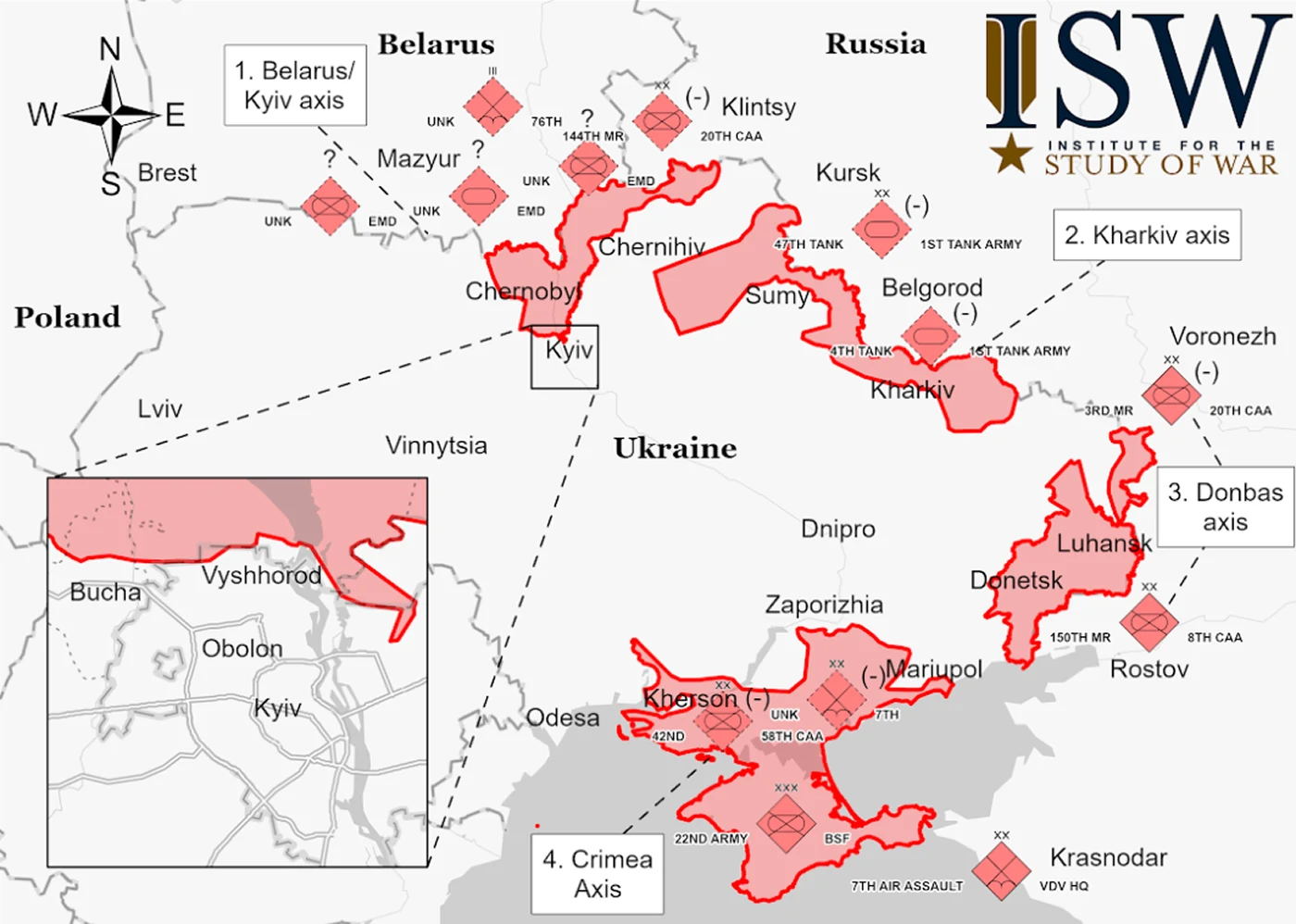
On the southern front, advanced elements of the Russian southern military grouping pushed outward from the occupied Crimean peninsula, advancing past the city of Kherson to launch initial probing attacks against the defensive perimeters of Mykolaiv. Despite this rapid geographic movement, heavy fighting continued in the rear sectors, as the strategic city of Kherson remained contested and uncaptured by Russian infantry.
This operational layout led independent analysts to condemn the mainstream international cartography of the war, which routinely utilized solid red shading to depict vast swathes of Ukrainian territory as being under absolute Russian control. In reality, the invasion pattern resembled a “highway warfare” model identical to late-stage conflicts in Syria: Russian armored columns moved rapidly along primary transit roads through open terrain without establishing rear-area security, leaving their supply lines completely exposed to localized Ukrainian counter-attacks, territorial ambushes, and aerial interdictions.
Strategic Infrastructure Strikes and the Integration of Autonomous Warfare
As the ground campaign devolved into fragmented encounters, the Russian military command turned its attention toward paralyzing Ukraine’s logistical interior through precision missile strikes on industrial infrastructure. Simultaneously, the conflict witnessed the battlefield validation of newly integrated autonomous combat systems.
The targeting of energy nodes was designed to choke the operational mobility of the Ukrainian Armed Forces. However, this material destruction was quickly offset by the highly effective deployment of tactical combat drones against critical Russian air defense assets.
The Vasilkiv Oil Depot Fire and Infrastructure Sabotage
In the early morning hours of February 27, a powerful Russian cruise missile strike targeted a major commercial petroleum storage facility in the municipality of Vasilkiv, located approximately 30 kilometers southwest of Kyiv. The resulting explosion generated a massive fuel fire that lit up the metropolitan horizon, destroying vital fuel reserves utilized to sustain the operational mobility of local Ukrainian armored and mechanized brigades.
Concurrently, tactical missile strikes caused a severe rupture of a primary natural gas pipeline infrastructure corridor inside Kharkiv. While these targeted actions caused localized energy disruptions and significant environmental damage, they ultimately failed to paralyze the decentralized supply chains of the Ukrainian military, which had already dispersed its fuel and ammunition stocks into mobile tactical hidden reserves ahead of the initial invasion.
The Unveiling of Bayraktar TB2 Drone Capabilities Against Russian Air Defenses
The defining technological development of Day 4 was the formal deployment of Ukrainian Bayraktar TB2 semi-autonomous combat drones into an offensive role against invading columns. Prior to this point, the operational status of Ukraine’s drone fleet remained obscured by strict operational security protocols.
The Ukrainian General Staff shattered this informational void by publishing verified combat footage recorded directly from the operator consoles of the Turkish-manufactured drones. The digital readouts captured the precise targeting and total kinetic destruction of a Russian Buk surface-to-air missile system inside the Zhytomyr Oblast, along with parallel strikes against supply convoys in the Berdyansk sector. The ability of the Bayraktar TB2 to operate freely and systematically liquidate high-value air defense assets exposed severe gaps in Russia’s integrated mobile radar shielding and signaled a major shift toward automated interdiction warfare.
The Geopolitical Pivot: Western Re-Armament and Turkey’s Maritime Blockade
The evident failure of the Russian military to achieve an instantaneous victory over Kyiv triggered a dramatic and historic realignment across European diplomatic and security architectures. Decisions that had been stalled for decades were finalized within hours, transforming the international parameters of the conflict.
The geopolitical isolation of the Russian Federation accelerated rapidly as Western states transitioned from standard economic warnings to direct military involvement. This structural shift was highlighted by a total reversal of post-WWII defense policies and the enforcement of international maritime restrictions.
Germany’s Historic Turn and the Flow of European Weapons
The fourth day of the war marked a permanent transformation in the foreign policy of the Federal Republic of Germany, shattering decades of post-World War II defensive restraint. Bowing to intense international pressure and the immediate reality of the invasion, the German government announced a complete reversal of its prohibition on exporting lethal hardware to active combat zones, authorizing the immediate transfer of Panzerfaust 3 anti-tank weapons and FIM-92 Stinger man-portable air defense systems directly to the Ukrainian military.
This historic policy shift unlocked a massive wave of parallel military aid across the European Union, transforming Western nations into active logisticians for the Ukrainian defense. Observers ironically noted that German-manufactured “Panzerfaust” (armor-fist) weapon systems were now actively being distributed to Ukrainian infantry units to hunt down Russian “Tiger” armored vehicles on the approaches to Kyiv.
The Enforcement of the Montreux Convention by Ankara
Simultaneously, the maritime logistics of the conflict were permanently altered by a decisive legal determination enacted by the Republic of Turkey. Following formal diplomatic petitions from Kyiv, the Turkish government officially recognized the situation in Ukraine not as a localized security dispute, but as a formal de jure state of war, thereby triggering the emergency activation of Article 19 of the Montreux Convention.
This international legal mechanism authorized Ankara to completely close the Bosporus and Dardanelles straits to all military vessels belonging to the belligerent powers. While the restriction applied neutrally to both states on paper, its practical impact fell entirely on the Russian Navy. Because the core components of the Russian Black Sea Fleet were already inside the basin, the closure effectively choked off Russia’s naval reserve fleet in the Mediterranean, preventing the Kremlin from deploying reinforcing surface combatants or landing ships to support operations along Ukraine’s southern coastline.
Information Warfare, Casualty Admissions, and Nuclear Saberrattling
The systemic failure of the Russian state to control the informational space of the war led to visible institutional instability inside the Russian administrative apparatus. Faced with an un-degradable flow of digital evidence documenting heavy equipment losses, state organs were forced to break their absolute silence regarding operational attrition.
The sudden exposure to severe material and human losses triggered an erratic, highly volatile reaction from the highest level of the Kremlin’s command structure. This psychological pressure resulted in a desperate resort to strategic nuclear intimidation against Western security partners.
The Russian Defense Ministry’s Fragmented Admissions of Attrition
For the first three days of the invasion, the official briefings issued by the Ministry of Defense in Moscow maintained a surreal narrative of zero casualties, claiming absolute success without a single drop of Russian blood. On the fourth day, this total informational blockade completely collapsed under the weight of thousands of geolocation videos showing captured soldiers, dead personnel, and burning columns.
Faced with a domestic audience that was rapidly discovering the truth through decentralized digital communication networks, the Russian Ministry of Defense issued its first formal admission that Russian servicemen had been killed, wounded, and taken prisoner. Although the state apparatus strictly refused to publish specific baseline numbers and falsely asserted that Ukrainian losses were exponentially higher, the admission itself signaled that the volume of casualties had reached hundreds of dead within ninety-six hours, making it structurally impossible to hide the loss from military families back home.
The “Leroy Jenkins” Tactical Failures and Estimated Casualties
Independent military analysis conducted by the Conflict Intelligence Team (CIT) evaluated the root causes behind this unprecedented opening-phase attrition. Experts concluded that the Russian command executed its initial thrusts in the style of the famous internet meme “Leroy Jenkins” — conducting blind, reckless armored rushes deep into hostile territory without tactical coordination, radar shielding, or infantry support.Based entirely on verified photographic and video documentation of destroyed formations, analysts calculated a highly conservative minimum baseline of 600 to 700 Russian personnel killed in action by Day 4, while noting that real unverified metrics incorporating inaccessible rural corridors likely placed the actual death toll between 1,000 and 2,000 casualties.
Nuclear Blackmail as a Symptom of Strategic Panic
The combined impact of frontline stagnation, heavy human losses, and an unprecedentedly unified Western economic response — including the freezing of the Central Bank of Russia’s foreign currency reserves and the disconnection of major banks from the SWIFT network — pushed Vladimir Putin into a state of visible strategic panic. In a televised meeting with his defense minister and chief of the general staff, Putin ordered the Russian Federation’s strategic nuclear forces to be transferred to a “special combat duty mode.” This administrative directive effectively shortens the launch sequence for silo-based and mobile intercontinental ballistic missiles (ICBMs), reducing readiness times to a bare minimum. Rather than a calculated projection of strength, international security analysts interpreted this nuclear saberrattling as a classic act of street-level intimidation by a dictator who realized his conventional blitzkrieg had failed.
With the failure of the initial rapid-capture strategy, experts warned that the Kremlin would inevitably abandon its uncoordinated armored rushes and pivot toward its traditional “Syrian-style” siege doctrine: the total, indiscriminate flattening of Ukrainian municipal centers via massed heavy artillery, thermobaric multiple rocket launchers (TOS-1A), and unguided carpet-bombing, completely disregarding civilian casualties to force a territorial surrender.
This analytical report was compiled based on the briefings provided by the Conflict Intelligence Team (CIT) on Michael Nacke’s YouTube channel →